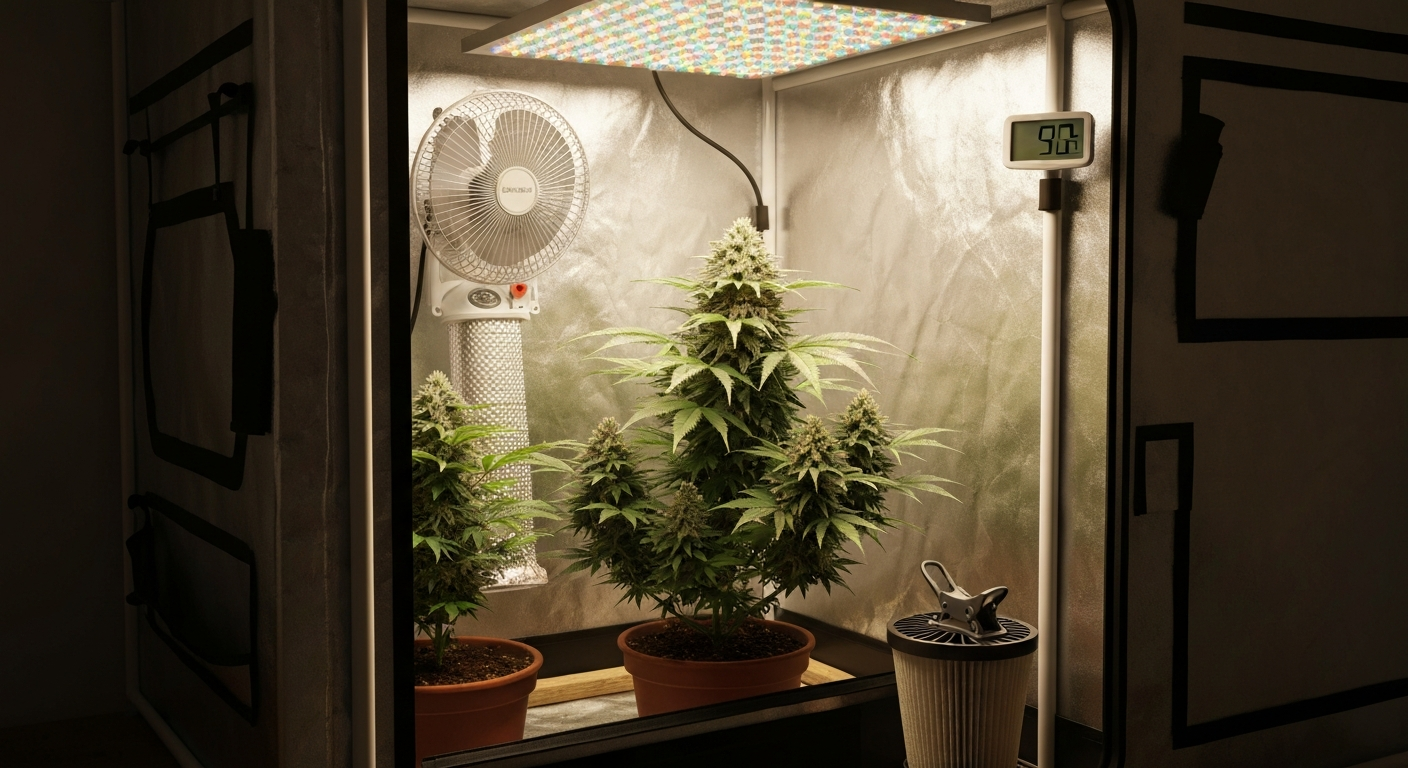
To make cannabis plants grow tall, you need to line up three things at once: genetics that are wired for vertical growth, enough uninterrupted vegetative time under strong light, and a root zone with room to match. Get all three right and plants will climb steadily. Miss one, cramped pot, weak light, or a strain that stops at 60 cm no matter what you do, and you'll hit a ceiling early. This guide walks through every lever you can pull, whether you're growing indoors under LEDs, outdoors in a backyard bed, or in a hydroponic reservoir.
How to Make Cannabis Plants Grow Tall: Guide for Home Growers
Marcus Holbrook
8 Aug 2026
Who this guide is for and what you can realistically expect
If you've grown a plant or two and felt disappointed by how short or sparse they came out, this is for you. It's also useful if you're planning your first grow and want to avoid the container-too-small or wrong-strain mistakes that cap height before you even get started. I've made both errors myself, and they're easily avoided with a little upfront planning.
Realistic expectations matter here. Indoors, well-grown photoperiod sativa-dominant plants can reach 120–200 cm with extended veg and generous pots. Most autoflowers top out at 50–120 cm regardless of what you do. Outdoors, the ceiling is much higher, some sativa-dominant varieties grown from early spring in a sunny climate can exceed 3 m. The strategies in this guide can nudge plants toward the top of their genetic range, but they cannot push a plant past its genetic ceiling. Understanding that upfront saves a lot of frustration.
Legal compliance and responsible growing
Before you do anything else, check the specific laws in your jurisdiction. Cannabis cultivation laws vary enormously, by country, by state or province, and sometimes by local municipality. In places where home growing is permitted, there are usually plant-count limits, possession limits, and rules about visibility or security. Some jurisdictions allow growing only for personal medical use with registration. Others prohibit all cultivation entirely.
This guide is written for growers in places where home cultivation is legal. Nothing here is intended to encourage or assist illegal activity. If you're unsure about your local rules, consult a legal professional or your relevant government health or agriculture authority before starting. Growing within the rules also means thinking about odor, light pollution, and access control, especially if taller outdoor plants become visible over fences. Being a responsible grower protects you and makes things easier for everyone in the cannabis home-growing community.
The primary factors that control how tall your plant gets
Height is the result of several factors stacking on top of each other. Remove any one of them and the others can't compensate fully. Research measuring broad-sense heritability in cannabis confirms that genetics explain a substantial and measurable portion of final plant height, meaning strain choice is genuinely predictive, not just marketing. But genetics set the ceiling, not the floor. Environment and management determine how close you get to that ceiling.
- Genetics: The strain's DNA sets the potential height range. Sativa-dominant photoperiod varieties have the highest ceilings. Autoflowers are genetically capped by flowering-time loci that trigger flower regardless of light schedule.
- Light: Both the intensity (PPFD) and the duration (photoperiod) affect how long vegetative growth continues and how vigorously it happens. Higher daily light integral during veg drives faster, bigger growth.
- Nutrients: Nitrogen fuels vegetative growth. Without adequate N during the veg phase, internodes stay short and stems stay thin.
- Root space: A pot that's too small physically restricts shoot growth. Research shows that doubling pot volume increases total plant biomass by roughly 43% on average — that effect is real and significant.
- Environment: Temperature, humidity, CO2 levels, and airflow all influence the rate of growth. Chronic stress from any of these factors will suppress height.
Of these, growers most commonly underestimate root space. I've seen healthy-looking plants stall completely at 40 cm simply because they were rootbound in a 3-litre pot. Repotting at that stage recovered growth, but lost time that could have been avoided with a bigger starting container or timely transplant.
Strain types and how they affect height
Sativa vs indica tendencies
Sativa-dominant varieties tend to grow tall and stretchy with long internodes and narrow leaves. Indica-dominant varieties typically stay shorter and bushier with tighter internodes. This isn't an absolute rule, there are compact sativas and surprisingly tall indicas, but as a general guide for height goals it holds up. If height is your main objective, starting with a sativa-dominant or sativa-leaning hybrid gives you the best genetic foundation. For a focused walkthrough on selecting and cultivating tall sativa varieties, see our detailed guide on how to grow sativa.
Photoperiod plants vs autoflowers
This distinction is arguably more important for height than the sativa/indica split. Photoperiod plants stay in the vegetative phase as long as you keep the light schedule at 18+ hours of light per day (indoors), or until the natural shortening of days triggers them (outdoors). That means you control when flowering starts and therefore how long the plant has to grow tall. Autoflowers, by contrast, are genetically wired to begin flowering based on age rather than light schedule. That switch is controlled by specific loci in the plant's genome (including FT-like variants identified in research), and you cannot override it with light manipulation. Most autoflowers begin flowering at 3–5 weeks old and finish at 70–90 days total, which limits the vegetative period and therefore final height. Modern autoflower breeders list mature heights of roughly 50–120 cm for most lines, while photoperiod varieties, especially sativa-dominant ones, can be vegged for months and trained to reach well beyond that.
| Type | Typical Indoor Height | Veg Phase Control | Best For Height Goals |
|---|---|---|---|
| Sativa-dominant photoperiod | 100–200+ cm | Full grower control | Yes — highest ceiling |
| Indica-dominant photoperiod | 60–120 cm | Full grower control | Moderate — manageable indoors |
| Sativa-dominant autoflower | 70–120 cm | None — age-triggered | Limited |
| Indica-dominant autoflower | 50–80 cm | None — age-triggered | No — naturally compact |
Choosing the right strain for tall growth
Strain selection is the single highest-leverage decision you make before the grow even begins. For a clear step-by-step introduction to starting and caring for cannabis, see how to grow canna plants. Seed-bank datasheets list expected height ranges, and while those numbers are sometimes optimistic, they give you a useful relative comparison. OG Kush, for example, is listed by major breeders at roughly 90–160 cm indoors. Landrace sativas or sativa-dominant crosses can push well past that with extended veg time.
When choosing a strain or sourcing a clone, here's what to look for and ask about:
- Is it a photoperiod or autoflowering variety? If height is a priority, start with photoperiod.
- What is the expected indoor height range on the breeder's datasheet? Look for varieties listed at 100 cm or more.
- What is the sativa/indica ratio or genetic lineage? Strains with significant tropical sativa heritage tend to stretch more.
- How long does the breeder recommend for the vegetative phase? Longer veg recommendations correlate with taller final plants.
- If sourcing clones, ask the supplier about the mother plant's height history and growing conditions. A clone taken from a tall, healthy mother is a good starting point.
One honest caution: some very tall sativas (think equatorial landrace types) can be challenging to manage indoors because they stretch dramatically during the first few weeks of flower. If you're growing in a tent with a fixed ceiling, a more moderate sativa-dominant hybrid might be a smarter choice than a pure sativa that doubles in height after you flip to 12/12.
Planning your vertical grow before you plant anything
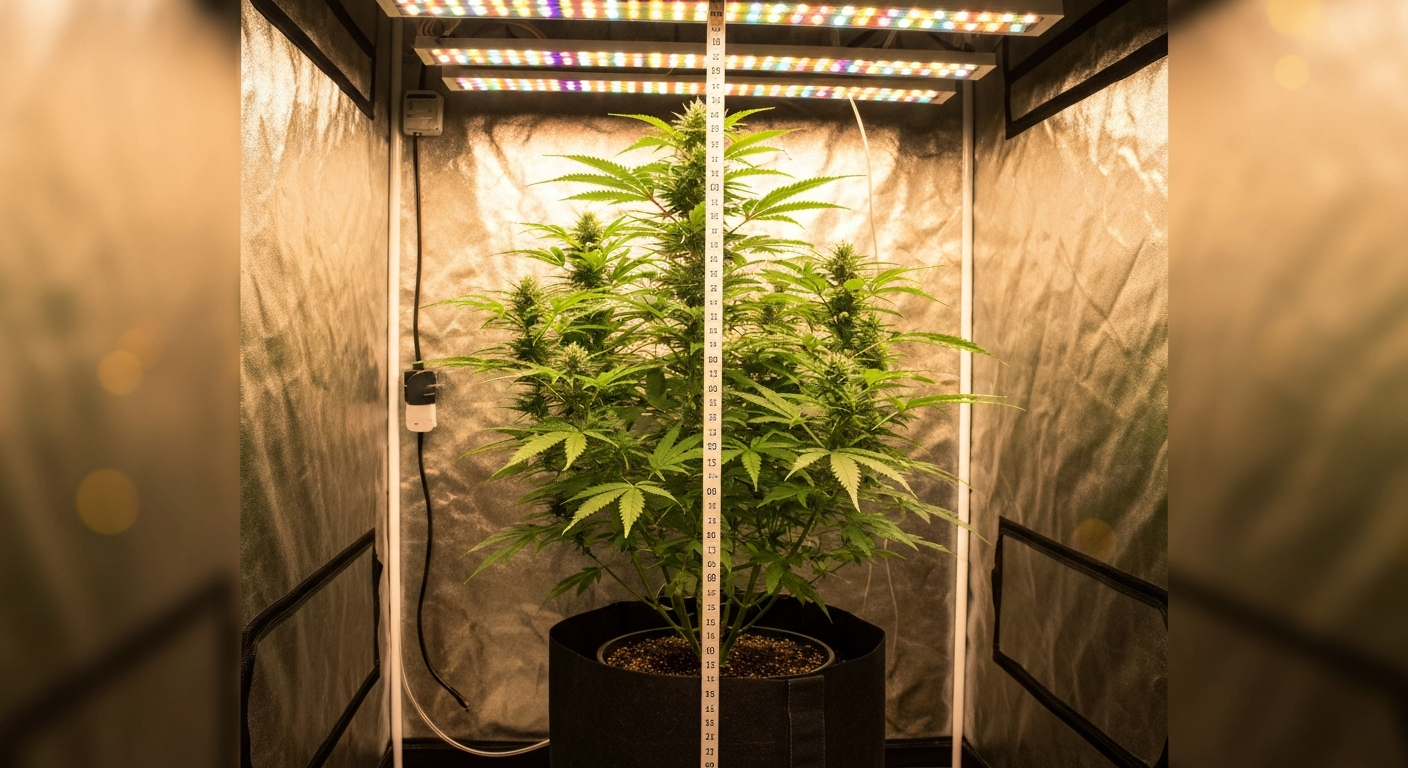
Measure your grow space ceiling-to-floor before you commit to a strain. Then subtract the space taken up by your light fixture and any hanging hardware (typically 20–40 cm for modern LED bars), plus the depth of your pot or reservoir (15–30 cm depending on container). The remaining vertical space is your canopy budget. For example, a 240 cm tent with a 30 cm LED clearance and a 25 cm pot gives you roughly 185 cm of usable plant height, before you factor in the stretch that happens during the first few weeks of flower.
Most photoperiod plants stretch 30–100% during the first two to three weeks of the flowering phase, depending on genetics. A sativa-dominant strain that's 80 cm tall at the flip could easily reach 140–160 cm by week three of flower. Plan for that stretch, or you'll find yourself bending tops sideways to avoid burning them on your lights. If you're tight on vertical space, initiate flowering earlier than you think you need to.
- Measure total ceiling-to-floor height in your grow space.
- Subtract light fixture clearance (typically 30–45 cm for LED bars, more for HPS due to heat).
- Subtract container depth.
- Multiply the remaining figure by 0.6–0.7 to leave room for flowering stretch — this is your target height at the flip.
- Choose a strain whose indoor height listing fits within that calculated range.
- Set a veg-phase end date based on when plants hit that target height.
Indoor strategies to grow taller cannabis plants
Pot size and growing media
Container size is where I see beginners make the most costly and easily avoidable mistake. A rootbound plant simply cannot grow tall, the restricted root zone throttles shoot growth regardless of how good your light or nutrients are. For photoperiod plants you want to veg to significant height, I recommend starting in small containers for germination (1–2 litres), transplanting to intermediate containers (5–7 litres) at the seedling stage, and moving to final containers of at least 15–20 litres for plants you want to exceed 100 cm. Some growers use 25–40 litre pots for very large indoor specimens. The research supporting this is not just anecdotal: a published meta-analysis across plant species found that doubling rooting volume increased above-ground biomass by roughly 43% on average. That effect is real.
For growing media, a well-aerated cannabis-specific soil mix or a peat/coco coir blend with good drainage supports vigorous root growth. Dense, compacted soils hold water too long and create the root hypoxia that limits photosynthesis and slows shoot growth. For detailed guidance on what soil to grow cannabis in, see our article on what soil to grow cannabis. If you're using coco coir, note that it's essentially inert and requires you to supply all nutrients through irrigation, it rewards growers who track EC (electrical conductivity) carefully. Avoid the temptation to pack containers tightly; roots need oxygen as much as they need water.
Lighting for vegetative vigor
During the vegetative phase, light intensity and duration are your two main dials. Photoperiod plants need 18 hours of light per day (a standard 18/6 schedule) to stay in veg. For PPFD, research using controlled cannabis environments shows vegetative growth responds positively to PPFDs in the range of roughly 400–700 µmol/m²/s at the canopy, with some trials pushing to 900 µmol/m²/s for faster growth. Below 150–200 µmol/m²/s, plants will survive but won't grow vigorously.
Light spectrum also matters in a specific, practical way. Blue-heavy light (the 400–500 nm range) suppresses internode elongation and keeps plants compact. Far-red and red-heavy spectra promote stem stretch. This is not a bug, it's a feature you can use deliberately. If you want taller plants, dial back blue-heavy supplementation slightly and ensure your fixture has a good red and far-red component. Most modern broad-spectrum LED bars are designed to balance this, but single-spectrum blue grow lights common in vegetative stages will actively suppress the height you're trying to achieve.
For fixture placement, follow your LED manufacturer's PPFD map rather than guessing by wattage. Modern LED bars are typically hung 30–45 cm above the canopy during veg to hit target PPFD ranges. HPS fixtures need more distance because of radiant heat, bringing them too close causes heat stress that actually slows growth and compresses internodes.
Nutrients during vegetative growth
Nitrogen is the primary driver of vegetative growth. During the veg phase, you want a feed high in N relative to phosphorus and potassium. Hydroponic feed charts from major nutrient manufacturers reflect this clearly: target EC values during vegetative growth are typically around 1.0–1.6 mS/cm (roughly 500–800 ppm on a 0.5 conversion). Seedlings and young clones should start lower, around EC 0.4–0.6, to avoid salt burn. When you transition to flower, shift toward lower N and higher P/K, with EC targets moving to around 1.4–1.8 mS/cm in early-to-mid flower.
| Growth Stage | Target EC (mS/cm) | Approx. PPM (0.5 conversion) | N:P:K Emphasis |
|---|---|---|---|
| Seedling / clone | 0.4–0.6 | 200–300 ppm | Balanced, low concentration |
| Early veg | 0.8–1.2 | 400–600 ppm | High N |
| Mid-to-late veg | 1.2–1.6 | 600–800 ppm | High N |
| Early flower (transition) | 1.4–1.8 | 700–900 ppm | Reducing N, building P/K |
| Mid-late flower | 1.6–2.0 | 800–1000 ppm | High P/K, low N |
Environment: temperature, humidity and airflow
Vegetative cannabis grows best at temperatures between 22–28°C (72–82°F) with relative humidity of 50–70%. Temperatures below 18°C slow growth noticeably; above 30°C, photosynthesis becomes less efficient and you risk heat stress. Airflow matters too, a gentle oscillating fan strengthens stems (a process called thigmomorphogenesis) and prevents hot or humid pockets that invite mold. CO2 levels in a well-ventilated room or tent with regular air exchange are generally fine at ambient atmospheric levels (~400 ppm). Some advanced growers supplement CO2 to 1000–1500 ppm in conjunction with high PPFD to push growth rates, but this adds cost and complexity that most home growers don't need.
Vegetative timing: how long to veg for maximum height
The longer you veg a photoperiod plant, the taller it will be at the flip. Most indoor growers run 4–8 weeks of veg for moderate-sized plants. To push height, extend that to 10–14 weeks, or simply wait until plants reach the target height you calculated for your space. Monitor actively: some sativa-dominant plants grow 5–8 cm per day during peak veg, so a couple of weeks' delay in flipping can add 50–70 cm. Just remember the stretch multiplier when you do flip: a plant that's 90 cm at 12/12 can easily hit 150–160 cm before vertical growth stops.
Training and pruning techniques that affect height
Training methods interact with height in ways that are worth understanding before you pick an approach. Topping, cutting the main apical tip, redirects growth energy into multiple lateral branches, creating a bushier, multi-cola plant that's shorter overall. If your goal is maximum single-stem height, don't top. If your goal is to fill horizontal canopy space with multiple tall-ish colas, topping plus low-stress training (LST) is effective. LST involves tying branches down to encourage horizontal growth and light penetration without removing plant tissue, it can be used to expose lower growth sites and get more height from side branches without adding vertical height to the main stem. Supercropping (deliberately stressing and bending stems without breaking them) is another tool to manage height or redirect growth. If height maximization is your primary goal, minimal training interference during veg gives the most vertical result. For step-by-step advice on pruning and managing growth as plants develop, see how to prune cannabis plants as they grow.
Hydroponic setups for faster, taller growth
Hydroponic systems, particularly deep water culture (DWC) and recirculating DWC (RDWC), are well-documented for producing faster vegetative growth than soil because roots have continuous access to oxygenated nutrient solution with minimal resistance. In practice, plants in DWC often show noticeably faster veg growth than comparable soil grows, which means you can reach your target height in less time. The trade-off is that hydro systems are less forgiving: nutrient, pH and dissolved oxygen issues can escalate quickly.
For DWC specifically, keep reservoir temperature between 18–21°C (65–70°F), warmer water holds less oxygen and dramatically increases Pythium (root rot) risk. Aim for dissolved oxygen above 6 mg/L; an air pump with appropriate airstone output is the practical tool to achieve this. Experimental hydroponic studies report that maintaining dissolved oxygen above roughly 6 mg·L⁻¹ enhances root respiration and nutrient uptake in fast‑growing crops, so growers commonly target >6 mg·L⁻¹ in reservoirs (specific target depends on temperature, salinity and altitude) Dissolved oxygen above ~6 mg·L⁻¹ improves root respiration and nutrient uptake. EC and pH management are the same targets as described in the nutrients section above. Coco coir in a drip system or recirculating nutrient film technique (NFT) are also effective for fast veg growth and give you a bit more buffer than DWC if you're newer to hydroponics.
Outdoor strategies to grow taller cannabis plants
Site selection and sun exposure
Outdoors, sunlight is free and abundant, but only if your site gets enough of it. Cannabis needs at least 6 hours of direct sunlight per day to grow acceptably; for maximum height and vigor, you want 8–12 hours of unobstructed direct sun, ideally with a southern exposure (in the northern hemisphere) or northern exposure (in the southern hemisphere). Shade from buildings, trees, or fences dramatically reduces DLI and stunts growth. If your best available site gets partial shade, the plant will still grow but won't reach its genetic potential.
Wind is a secondary consideration. Some wind strengthens stems, but persistent strong winds physically damage plants and cause chronic stress that suppresses growth. A windbreak, a fence, hedge, or wall that blocks prevailing winds, can meaningfully improve plant growth on exposed sites without blocking sun.
Soil preparation for outdoor height
Native garden soil is rarely ideal for cannabis. Most growers get better results by either amending in-ground soil deeply (60 cm or more) with compost, perlite, and balanced slow-release nutrients, or by planting into large raised beds or in-ground containers. For an outdoor plant you want to grow very tall, an in-ground bed or a large fabric container (50–100+ litres) is ideal, the unrestricted root zone allows the plant to match its potential above-ground size. I've found that digging a wide, deep planting hole (60 cm × 60 cm × 60 cm minimum) and backfilling with amended soil makes a dramatic difference compared to simply planting into hard, compacted native ground.
pH is important outdoors just as it is indoors. Most cannabis cultivars do best in soil with a pH of 6.0–7.0, with 6.3–6.8 being the common sweet spot. Soil that's too acidic or alkaline locks out key nutrients even if they're physically present in the soil, leading to deficiencies that slow growth. Test your soil with an inexpensive meter or test kit before planting and adjust with lime (to raise pH) or sulfur (to lower it) as needed.
Timing your outdoor grow for maximum vegetative growth
Photoperiod plants outdoors stay in the vegetative phase as long as day length is above roughly 14–15 hours. In most temperate climates in the northern hemisphere, that means planting as early as possible after last frost, typically late April to late May depending on your latitude and local climate. Starting early from seed or clone indoors (under 18+ hours of light) and transplanting outdoors in late spring gives you the longest possible vegetative window before the summer solstice marks the beginning of shortening days. Plants started indoors in February or March and moved outside in May can reach 2–3 m before they begin flowering in late summer. Every week of additional vegetative growth outdoors translates directly to more vertical growth, since sativa-dominant plants in particular grow rapidly in warm summer conditions with 12+ hours of daily direct sun.
Climate considerations
Temperature has a significant effect on outdoor growth rates. Cannabis grows fastest in daytime temperatures of 24–30°C. Cold nights (below 15°C) slow growth and can cause stress responses that compact internodes. If you're at a higher latitude or elevation where cool nights are common, a greenhouse or polytunnel dramatically extends the viable growing season and keeps nighttime temperatures from suppressing growth. Humidity matters too: high humidity (above 70% during flowering) creates conditions for powdery mildew and botrytis, particularly in dense canopies, relevant when you've grown a very tall, bushy plant with tight interior airflow.
Transplanting, watering, and common growth problems
Transplanting for continuous growth
Transplanting at the right time prevents root restriction from throttling vertical growth mid-veg. The rule I use: transplant when you can see roots beginning to circle the bottom of the current container, or when the plant looks disproportionately large for the pot and starts showing signs of stress despite adequate water and nutrients. Transplant shock is real but brief, most plants recover within 3–5 days. Minimize it by keeping the root ball intact, watering the new container thoroughly before and after transplanting, and avoiding nutrient feeds for the first 2–3 days post-transplant.
Watering practices that support height
Both overwatering and underwatering suppress growth, but overwatering is more common and does more consistent damage. Saturated soil reduces root oxygen (root hypoxia), which measurably reduces photosynthesis per unit leaf area and limits shoot growth. The standard advice to water when the top 2–3 cm of soil feels dry is a reasonable starting point, but substrate type, pot size, plant size, and ambient temperature all affect how quickly a container dries out. In larger pots or coco, moisture sensors or simple lift-test weighing (a dry container is noticeably lighter) are more reliable than visual checking. A Calibrated Time Domain Transmissometry Soil Moisture Sensor Can Be Used for Precise Automated Irrigation of Container‑grown Plants (HortScience) demonstrates that calibrated TDT/TDR sensors and controllers can precisely maintain target substrate volumetric water content in container systems, though substrate‑specific calibration is required for accuracy. The goal is to maintain a wet-dry cycle that keeps roots well-oxygenated between waterings.
Troubleshooting common height-limiting problems
| Problem | Likely Cause | Fix |
|---|---|---|
| Plant stops growing upward mid-veg | Rootbound container | Transplant to a larger pot immediately |
| Tight internodes, very compact growth indoors | Too much blue light, light too close, or cool temps | Raise light, reduce blue ratio, check temp stays above 22°C |
| Excessive stretch (long, weak internodes) | Insufficient PPFD or light too far from canopy | Lower light to hit 400–700 µmol/m²/s at canopy |
| Yellowing lower leaves during veg | Nitrogen deficiency | Increase N feed; check pH is in range (6.0–7.0 soil, 5.5–6.5 hydro) |
| Slow growth despite good light and nutrients | Overwatering/root hypoxia | Let substrate dry out more between waterings; check drainage |
| Root rot in DWC (brown, slimy roots) | Water temp too warm or low DO | Chill reservoir to 18–21°C; increase aeration to achieve >6 mg/L DO |
Your next-steps checklist
If you're ready to plan a grow with maximum height in mind, work through this checklist before you start. Ticking off each point before germination removes the most common barriers to tall, vigorous plants.
- Confirm your grow is legal in your jurisdiction and that you understand local plant-count and visibility rules.
- Measure your grow space and calculate your usable canopy budget (ceiling minus light clearance minus pot depth, multiplied by 0.6–0.7 to account for flowering stretch).
- Choose a sativa-dominant photoperiod strain with an indoor height listing that fits your canopy budget. Confirm with the seed bank or clone supplier.
- Source containers that are 15–20 litres minimum for final transplant of indoor plants; 50+ litres or unrestricted in-ground beds for outdoor grows.
- Set up your vegetative lighting to deliver 400–700 µmol/m²/s PPFD at canopy height on an 18/6 schedule.
- Check your light spectrum: ensure your fixture includes red and far-red output, not only blue, to avoid suppressing internode elongation.
- Prepare your nutrient program: start EC at 0.4–0.6 for seedlings, ramp to 1.2–1.6 for mid-veg, and plan the N-to-P/K shift at flower transition.
- For hydroponic grows: set up temperature control to keep reservoir at 18–21°C and aeration to achieve dissolved oxygen above 6 mg/L.
- Plan your transplant schedule: small starter pot, intermediate container at 2–3 weeks, final container before roots begin to circle.
- Set a target height for flipping (indoors) or a calendar date for the first outdoor transplant (as early as post-frost as possible).
- Review training options: avoid topping if single-stem height is the priority; use LST only if you need to manage canopy spread.
Growing tall cannabis plants indoors or outdoors isn't complicated, but it does require those factors to align, genetics, light, nutrients, and root space all working together from week one. Skimping on any single piece will limit the whole plant. With the right strain in a big enough container under adequate light, and with the vegetative phase extended to your planned target height, you'll find cannabis is remarkably willing to climb.
FAQ
What are the primary factors that determine how tall a cannabis plant will grow?
Genetics is the biggest determinant (strain/chemotype and photoperiod genes). Environment and culture modify genetic potential: light intensity and spectrum (DLI/PPFD and far‑red/blue balance), root volume (pot size or hydro reservoir), nutrient program (especially nitrogen during veg), water and root oxygenation, and temperature/humidity. Photoperiod timing (length of vegetative phase) and training/pruning techniques also directly change final height.
How should I choose a strain if my goal is maximum height?
Pick genetics known for tall growth: sativa‑dominant and many outdoor/landrace types reach greater heights than indica‑dominant or many autoflowers. Avoid typical autos if you want extreme height — autos flower on age and usually stay shorter. Check breeder datasheets and pick photoperiod strains with long flowering timelines and sativa lineage. Also check flowering‑time genetics (Autoflower loci) when selecting to ensure you can control veg duration.
Indoor: how can I maximize height without causing light stress or stretching?
Use high veg PPFD/DLI (aim for a canopy PPFD ~300–600 µmol·m⁻²·s⁻¹ depending on fixture capability), maintain sufficient distance from LEDs per manufacturer PPFD map, and avoid excessive far‑red or low blue which causes unwanted stretch. Increase veg duration (e.g., 18–24 h light) to allow more nodes, and use larger pots to prevent root restriction. Combine controlled nutrient (higher N) and steady watering, and use training tools (LST, topping) to manage internodal spacing while promoting vertical growth of main colas.
Outdoor: what practices help plants grow tallest and healthiest?
Select long‑season photoperiod sativa/outdoor strains and plant early to maximize vegetative days. Give full sun exposure, deep fertile soil or large grow bags/raised beds (ample root volume), and consistent irrigation and fertility with N‑focused veg feeds. Protect from wind and pests, and use staking/trellising for support. Timing is critical—plant early enough to allow long veg but comply with local laws on planting/harvest windows.
Hydroponics: how can hydro systems increase plant height and what must I watch for?
Hydro/DWC/RDWC and coco systems often produce faster and taller vegetative growth because roots access oxygenated, balanced nutrients. Keep reservoir temps ~18–21 °C (65–70 °F), maintain dissolved oxygen >6 mg·L⁻¹, and sanitize to prevent Pythium. Because growth is rapid, closely monitor EC/ppm and pH, and be ready to increase support (stakes, trellis) and adjust training cadence.
What pot sizes or root volumes should I use to support taller plants?
Larger containers generally support greater aboveground growth. For small to medium indoor photoperiods aiming for tall plants, use 11–20 L (3–5 gal) or larger; for long veg and very large specimens, 20–50+ L (5–13+ gal) is common. Outdoors, plant directly in large raised beds or use large fabric pots (50–100 L) for maximal height. In hydro, increase reservoir/root zone volume and oxygenation for bigger root mass.
Next Article
How to Grow Indica Indoors: Complete Step-by-Step Guide
How to grow Indica indoors from seed or clone: step-by-step setup, lights, feeding, training, pests, harvest.