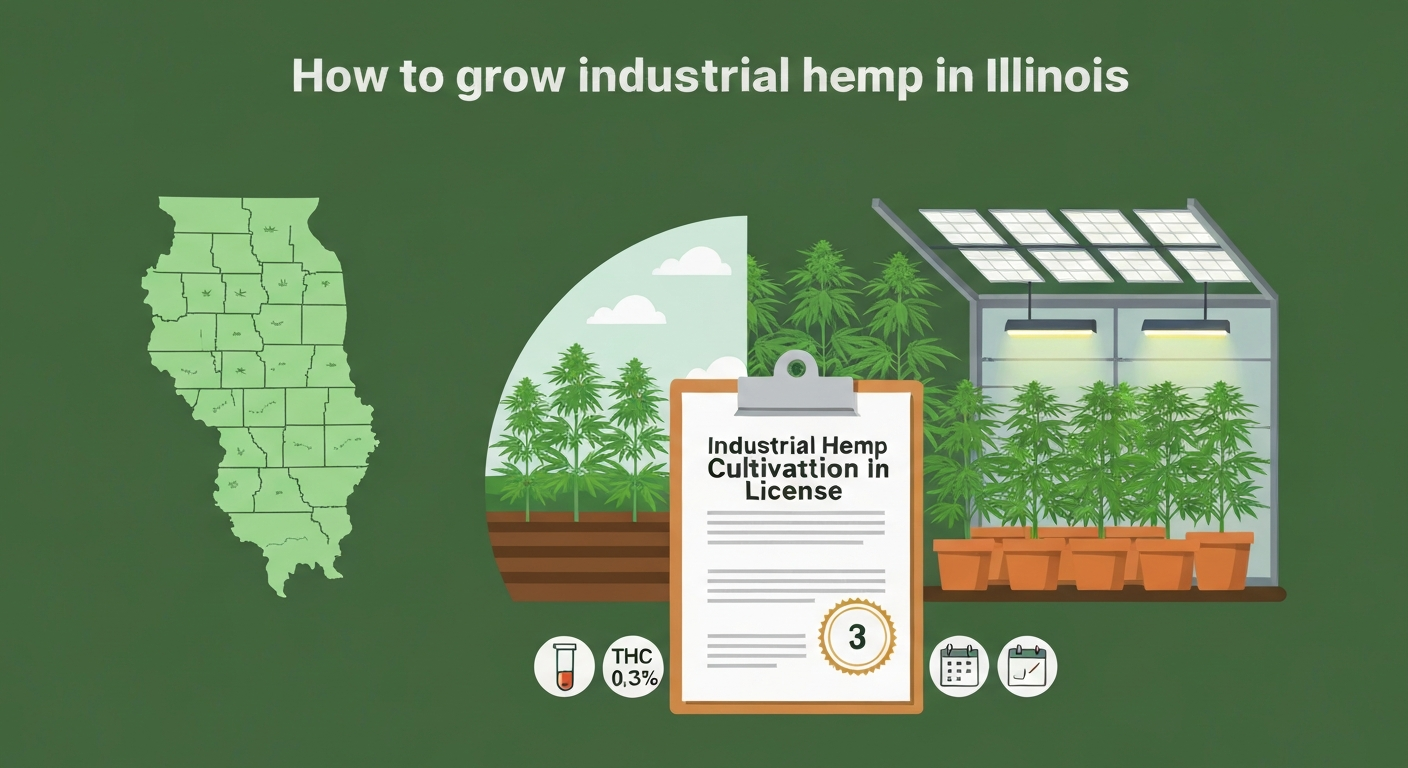
You can legally grow industrial hemp in Illinois, but only after obtaining an Industrial Hemp Cultivation License from the Illinois Department of Agriculture (IDOA). There is no provision for unlicensed personal or home grows of hemp in Illinois state law, the license requirement applies to everyone, from a small indoor hobby grower to a large commercial operation. The good news is that the licensing process is accessible, the fees are reasonable, and once you are licensed, you have a clear legal framework covering everything from planting through harvest and testing. This guide walks you through that framework and then takes you step-by-step through actually growing hemp in Illinois, whether you are working with an outdoor bed, a dedicated indoor space, or a small hydroponic setup. See our guide on how to grow industrial hemp (resource ID 12cd6237-64dd-4440-a202-90413f99a2c7) for detailed, step-by-step instructions on planting, care, and compliance. See our companion guide on how to grow hemp in Rust for platform-specific tips and a step-by-step walkthrough tailored to that environment.
How to Grow Industrial Hemp in Illinois: Legal Guide
Who this guide is for
This article is written for Illinois residents who want to grow industrial hemp at home or on a small plot, people who are curious about hemp cultivation for CBD, fiber, or grain but are not yet running a commercial farm operation. If you have never grown hemp before, or if you have grown other cannabis at home and want to understand how hemp differs legally and agronomically, you are in the right place. I will be honest with you: growing hemp in Illinois legally requires more paperwork than, say, growing tomatoes, but it is genuinely manageable. I will also tell you where the risks are, particularly around THC compliance testing, so you are not caught off guard.
The legal framework you need to understand
The federal definition of hemp
Under the Agriculture Improvement Act of 2018 (the Farm Bill), hemp is defined as Cannabis sativa L.) and any part of the plant with a delta-9 THC concentration of no more than 0.3% on a dry weight basis. That 0.3% threshold is the legal line between hemp and marijuana under federal law. USDA regulations in 7 CFR Part 990 further specify that labs must evaluate "total THC" using post-decarboxylation methods (or similarly reliable techniques) and must report the measurement of uncertainty (MU) alongside results. That MU detail matters practically: if your sample tests at, say, 0.32% but the MU puts the upper confidence interval below 0.3%, it can still be considered compliant.
How Illinois regulates hemp
Illinois adopted the federal 0.3% delta-9 THC standard through its own Industrial Hemp rules at 8 Illinois Administrative Code Part 1200. The IDOA administers the program. Under Section 1200.20, no person may cultivate industrial hemp in Illinois without a valid IDOA cultivation license, there is no personal-use carve-out, no home-grower exemption. If you are growing even a single hemp plant in your backyard without a license, it is treated the same as growing marijuana under state law. The minimum scale for a licensed operation is at least 0.25 acres of contiguous outdoor land, or at least 500 square feet of indoor cultivation space. Both thresholds are important: you cannot obtain a license for a 200-square-foot spare bedroom setup, but a converted garage or a modest outdoor garden plot can qualify.
Personal vs. commercial allowances
Illinois does not distinguish between personal and commercial hemp cultivation the way some states separate home cannabis grows from commercial ones. All hemp cultivation requires the same Industrial Hemp Cultivation License. What varies is the scope and cost of that license: a small indoor grower pays the same application fee as a large outdoor farmer, though the annual license fee may differ by duration chosen. Once licensed, you can grow hemp for any lawful purpose, CBD production, fiber, grain, or personal study, as long as you stay within the terms of your license, meet all reporting obligations, and pass THC compliance testing.
Applicant eligibility
If you or anyone listed on your application has been convicted of a controlled-substance-related felony within the past 10 years, IDOA will deny the application. This follows USDA policy embedded in the state rules at 8 IAC 1200.10(b). If that applies to you, speak with an attorney before applying, there is no point in spending time and money on an application that will be rejected at the eligibility stage.
How to register with the Illinois Department of Agriculture
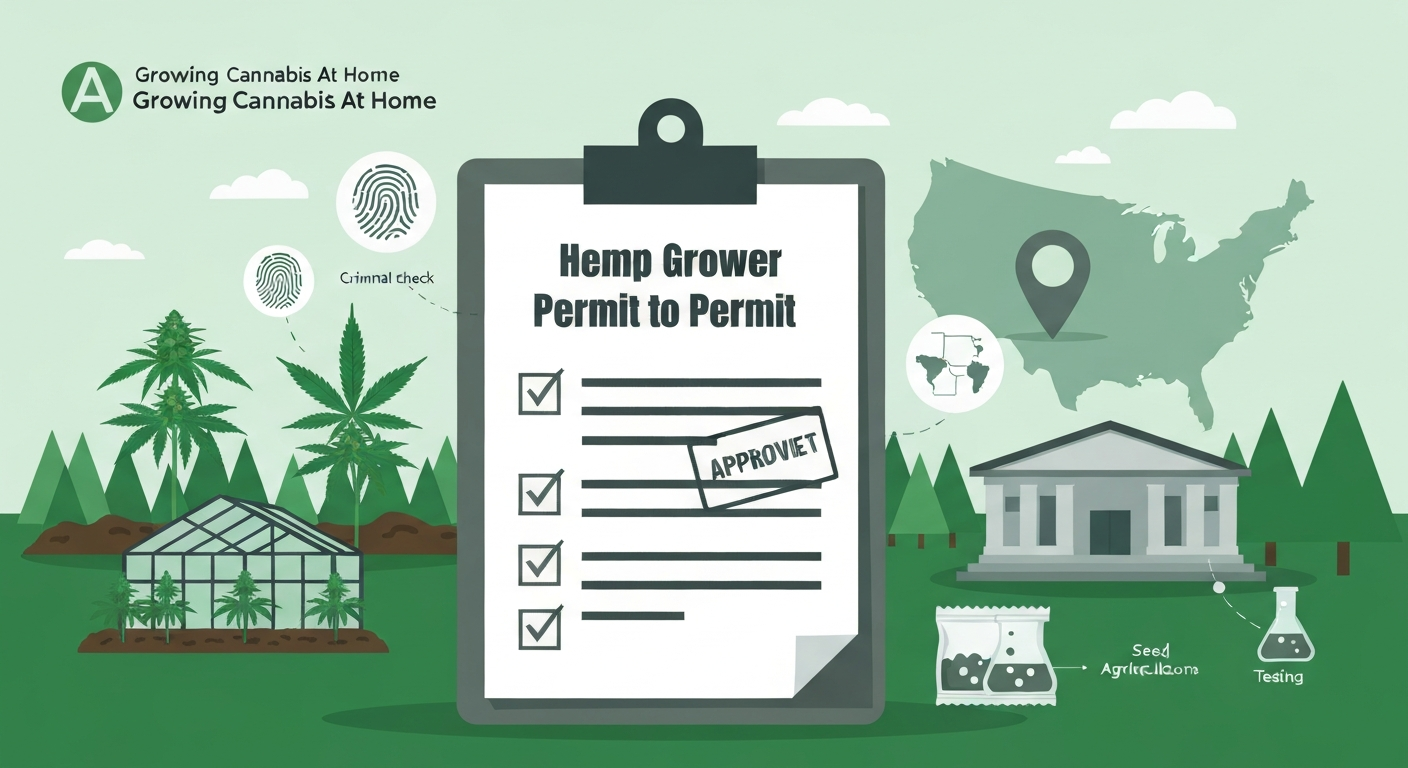
Applications are submitted online through the IDOA licensing portal (operated via NIC/NLS). If you're seeking similar licensing information for Oklahoma, see a concise guide on how to get license to grow hemp in Oklahoma. For step-by-step instructions on applying, see how do I get a permit to grow hemp. Before you sit down to fill it out, gather everything on this checklist, incomplete applications slow the process significantly.
- Government-issued photo ID for all applicants and any principal officers listed on the application.
- Business formation documents if applying as an LLC, corporation, or partnership (articles of incorporation, operating agreement, or equivalent).
- Legal land description for each contiguous outdoor parcel you intend to cultivate, including county and township information.
- GPS coordinates for each growing area (latitude/longitude for each corner point or a central point, depending on IDOA's current portal format).
- A scaled map or diagram showing growing area boundaries and dimensions — a hand-drawn map to scale is acceptable if GPS coordinates are accurate.
- For indoor spaces: the physical address, square footage calculation, and a floor-plan sketch identifying the cultivation area.
- Payment of the $100 application fee per noncontiguous land area or indoor area (paid at submission).
- Criminal history disclosure for all listed applicants — any controlled-substance felony conviction in the past 10 years is disqualifying.
- Contact information including a phone number and email address that IDOA can reach during business hours.
- Selection of license duration: 1-year ($375 per area), 2-year ($700 per area), or 3-year ($1,000 per area) — the $100 application fee is separate and non-refundable.
Once IDOA approves your application and you pay the license fee, you will receive your cultivation license with a license number. Keep that number accessible, you will reference it on harvest reports, FSA filings, and chain-of-custody documents throughout the season. Licenses are renewable through the same portal. If anything on your operation changes (new parcel, different growing location, change in principals), notify IDOA before making the change, not after.
When to call a lawyer or contact the IDOA directly
I want to be straightforward here: this article gives you a solid working understanding of the Illinois hemp program, but it is not legal advice. There are situations where spending an hour with an agricultural attorney is genuinely worth the cost.
- You or a household member has a prior drug conviction and you are unsure whether it falls within the 10-year disqualification window.
- You rent or lease your property and are not sure whether your landlord's consent affects your license application.
- You are growing on land subject to a deed restriction, HOA rules, or zoning overlay that may conflict with agricultural use.
- Your crop tests above 0.3% THC and you are deciding between requesting a retest, pursuing remediation, or destroying the lot.
- You want to sell hemp biomass or extract and need to understand whether you also need a processor registration.
- You are unsure how your homeowner's or farm insurance policy treats a licensed hemp operation — most standard policies exclude cannabis-related crops entirely, and you may need a specialty agricultural policy.
For general program questions, form locations, portal access issues, approved lab lists, sampling agent contacts, call or email the IDOA Bureau of Agricultural Products Inspection directly. They are genuinely helpful for navigating the administrative side of the program, and it is much faster than guessing.
Choosing the right seed and strain
Before you pick a variety, you need to decide what you are actually growing hemp for, because the answer changes everything about the plant you choose. The three main production types are CBD (cannabidiol) flower, fiber, and grain. Each has different plant architecture, harvest timing, and market pathway. For most small-scale or hobby growers in Illinois, CBD production is the primary goal, it produces the most value per square foot at small scale. Fiber and grain hemp are grown at scale for industrial buyers and require different processing infrastructure.
| Production Type | Plant Characteristics | Harvest Timing | Typical Use Case |
|---|---|---|---|
| CBD Flower | Short, bushy, many branches, dense floral clusters | Late September to mid-October in Illinois | Extracts, tinctures, smokable flower, topicals |
| Fiber | Tall (8-15 ft), single stalk, minimal branching | Mid-August to September (before full seed set) | Textiles, rope, insulation, paper |
| Grain/Seed | Medium height, branched tops for seed production | Late September to October (when seeds firm) | Hemp seed oil, protein powder, birdseed |
Certified and registered varieties
Illinois does not maintain its own state variety list, but USDA maintains a list of hemp varieties that have been produced and tested under approved state or tribal programs. Choosing a variety with a documented compliance history dramatically reduces your THC risk. Before purchasing seed, ask your supplier for the variety name, the COA (certificate of analysis) from the seed lot's most recent crop tests, and documentation that the variety is on USDA's approved variety list or has been tested under an IDOA-approved program. Keep all of this paperwork, if your crop tests hot, documented seed provenance is part of your defense and affects your retest eligibility.
Feminized vs. regular seed
For CBD production, feminized seed is almost always the right choice for small growers. Regular seed produces roughly 50% male plants, and males do not produce cannabinoid-rich flowers, they pollinate females, which redirects plant energy from flower production to seed production, reducing your CBD yield significantly. Feminized seed costs more per unit but removes the labor of identifying and removing males before they shed pollen. For fiber or grain production, regular seed or mixed-sex planting is normal and intended, since pollination is part of the grain production process.
Germination testing and seed documentation
Test germination rate before committing your full seed inventory to the ground. Place 10 seeds on a damp paper towel in a sealed bag at room temperature and check at 48, 72, and 96 hours. A reputable lot should show 80% or better germination. If you are seeing 60% or lower, account for that in your planting density rather than assuming every seed will sprout in the field. Keep your seed invoice, the variety's COA, and your own germination test notes in a cultivation log, IDOA may ask for cultivar documentation during an inspection.
Illinois planting calendar and site selection
Climate context for Illinois growers
Illinois spans a meaningful climate range from north to south. In northern Illinois (Chicago metro and north), the last spring frost typically falls between late April and mid-May, and the first fall frost arrives in early to mid-October. In central Illinois (Peoria, Springfield), last frost is typically mid-April, and first fall frost comes in mid-to-late October. Southern Illinois (Carbondale and south) enjoys a longer growing season, with last frost in late March to early April and first fall frost often not until late October or even November. Hemp is frost-sensitive, especially as seedlings and at flowering. Planting too early in northern Illinois is a common beginner mistake, I have seen growers lose entire transplant batches to a late May frost.
Sample planting timeline
| Task | Northern IL (Zone 5b) | Central IL (Zone 6a) | Southern IL (Zone 6b-7a) |
|---|---|---|---|
| Start seeds indoors | Late April | Early to mid-April | Late March to early April |
| Last expected frost | Mid-May | Mid-April | Late March to early April |
| Transplant outdoors | Late May to early June | Early to mid-May | Late April to early May |
| Direct seed outdoors | Late May | Early to mid-May | Late April |
| File FSA acreage report | Within 30 days of planting | Within 30 days of planting | Within 30 days of planting |
| Submit Harvest Report to IDOA | At least 30 days before harvest | At least 30 days before harvest | At least 30 days before harvest |
| Expected harvest window | Late Sept to mid-Oct | Late Sept to mid-Oct | Early Sept to mid-Oct |
Choosing and preparing your outdoor site
Hemp needs full sun, at minimum 6 hours of direct sunlight per day, and ideally 8 or more. Avoid low-lying areas that collect cold air in spring and fall, and absolutely avoid any site with standing water after rain. Hemp's biggest agronomic vulnerability is root rot from waterlogged soil, and Illinois clay soils are particularly prone to this. Raised beds or slightly elevated ground with good surface drainage makes a real difference. Your soil pH should sit between 6.0 and 7.0; get a soil test through the University of Illinois Extension before planting, it is inexpensive and will tell you what amendments to add. A soil test also establishes a baseline for your nutrient program.
Outdoor cultivation, step by step
Site preparation
Till or loosen your soil to at least 12 inches depth, hemp develops a taproot that reaches well below the topsoil layer, and compacted ground will stunt it. Incorporate compost (2 to 4 inches worked in) and any pH amendments your soil test recommends. If your soil is heavy clay, adding perlite or coarse sand to the top 6 inches improves drainage and aeration. Let the bed settle for a week if possible before planting.
Spacing and bed layout
For CBD production with feminized plants, space at 4 to 6 feet between plants in rows 6 to 8 feet apart. This gives each plant room to develop its full canopy and flower structure. For fiber hemp, much tighter spacing (roughly 4 inches between seeds in rows 4 to 8 inches apart) is standard, dense planting encourages tall, straight stalks with minimal branching. For grain, spacing is intermediate, around 6 to 9 inches in the row. Mark your GPS boundary coordinates as specified in your IDOA application so that if a sampling agent needs to locate your plot, there is no ambiguity.
Planting and transplanting
For transplants started indoors: harden off seedlings over 7 to 10 days before moving them to the field. Move them outside for progressively longer periods each day, starting with a few hours of morning shade and working up to full-day sun exposure. Transplant on a cloudy day or in late afternoon to reduce transplant shock. Water in thoroughly and expect some wilting the first 24 to 48 hours. For direct seeding: plant seeds 0.5 to 1 inch deep and keep the top inch of soil consistently moist until germination (typically 3 to 7 days in warm soil above 50°F).
Seasonal care tasks
- Weeks 1-3 after transplant: Water daily in dry weather, focusing on the root zone rather than overhead irrigation. Watch for cutworm damage at the stem base.
- Weeks 4-8 (vegetative growth): Reduce irrigation frequency as roots establish; water deeply twice per week in the absence of rain. Apply a balanced fertilizer (NPK around 3-1-2 ratio) at half the recommended rate and adjust based on plant response.
- Week 8 onward (pre-flower): Switch to a lower-nitrogen, phosphorus- and potassium-forward nutrient profile. Nitrogen-heavy feeding late in the season pushes leafy growth at the expense of flower and resin development in CBD varieties.
- File your FSA acreage report within 30 calendar days of planting — do not skip this step.
- Submit your Harvest Report to IDOA at least 30 calendar days before your planned harvest date — IDOA needs time to schedule a sampling agent.
- Pest and disease scouting: Walk rows at least twice per week, checking the underside of leaves and the base of stems.
- Weed control: Hemp out-competes most weeds once established, but it is vulnerable in the first 4 to 6 weeks — hand-weed or apply mulch around plants early in the season.
Indoor cultivation for hobby growers
Indoor hemp cultivation under an Illinois license requires at least 500 square feet of dedicated cultivation space. That is roughly a 20x25 foot room or a well-organized single-car garage. Indoor growing gives you control over light cycles, temperature, humidity, and pests that outdoor cannot match, but it requires upfront investment in equipment and consistent daily management. This section focuses on hobby-scale indoor setups appropriate for a new licensee.
Space planning and layout
Divide your 500+ square feet into at least two functional zones: a vegetative area (smaller, can use less intense lighting) and a flowering area (where plants will spend most of their time and where your yield is produced). For CBD hemp, you can run a single-zone setup and flip all plants to flower at the same time, which simplifies the process for beginners. Allow 4 to 6 square feet per plant in the flowering zone for a full canopy. Leave at least 24 inches of working space between rows for access, scouting, and air circulation.
Lighting
Full-spectrum LED is the practical choice for most hobby growers today. Modern LED fixtures produce the right spectral range for both vegetative and flowering stages, run cooler than HPS (high-pressure sodium), and cost less to operate. For vegetative growth, target at least 400 to 600 micromoles of PPFD (photosynthetic photon flux density) at canopy level. For flowering, aim for 600 to 900+ PPFD. During vegetative growth, run lights 18 hours on and 6 hours off. To trigger flowering in photoperiod hemp varieties, switch to a 12-hour on, 12-hour off schedule. Many hemp varieties are auto-flowering, which means they flower based on age rather than light cycle, these are more forgiving for beginners and allow 18 to 20 hours of light throughout their whole life.
Ventilation and environmental controls
Hemp is not particularly tolerant of heat or stagnant air. Keep daytime temperatures between 70°F and 85°F during the day and no lower than 60°F at night. Relative humidity should stay between 40% and 60% during vegetative growth and drop to 40% to 50% during flowering to reduce mold and mildew risk. Every indoor space needs active air exchange: an inline fan and carbon filter pulling air out of the room, with passive or active fresh-air intake. For a 500-square-foot room, a 6-inch inline fan rated for 400 to 500 CFM is a reasonable starting point. Oscillating fans within the canopy promote stem strength and prevent humidity pockets.
Indoor daily and weekly task list
- Daily: Check temperature and humidity (morning and evening); inspect plants for wilting, discoloration, or pest activity; top off reservoir or check soil moisture.
- Daily: Confirm lights are on/off on schedule; check that fans and exhaust are running.
- Every 2-3 days: Water soil-grown plants when the top inch of soil is dry; check runoff pH (target 6.0-7.0 for soil, 5.5-6.5 for hydroponic/coco).
- Weekly: Apply nutrients according to your feeding schedule; flush with plain water every 3-4 weeks to prevent salt buildup in soil.
- Weekly: Wipe down any spilled nutrient solution; inspect for early signs of mold on stems or soil surface.
- Every 2 weeks: Defoliate lower-canopy leaves that receive no light and could harbor moisture.
- Monthly: Clean and inspect fans and filters; recalibrate pH and EC meters with fresh reference solution.
- As needed: Adjust light height as plants grow to maintain target PPFD; update your cultivation log with observations and inputs applied.
Soil, nutrients, and water
Whether you are growing outdoors or indoors, hemp rewards a simple, consistent nutrient program more than a complicated one. For outdoor soil, a pre-plant application of balanced slow-release fertilizer plus compost provides most of what your plants need through mid-season. After that, a monthly side-dressing of compost tea or a diluted balanced liquid feed keeps plants healthy without pushing excess nitrogen into the late season. For indoor soil or coco, a three-phase approach works well: a higher nitrogen (N-P-K around 3-1-2) formula during weeks 1 through 6 of vegetative growth, a bloom transition formula (around 1-3-2) for the first 2 weeks of flowering, and a low-nitrogen high-potassium formula (around 0-3-3) for the final 4 to 6 weeks of flowering. Always water to at least 10% to 20% runoff to prevent salt accumulation and check runoff pH every feeding cycle.
Pest and disease management
In Illinois, the outdoor hemp growers I have talked to most often run into corn earworm, aphids, spider mites (especially in dry summers), and white mold (Sclerotinia) in wet falls. Indoors, fungus gnats, spider mites, and powdery mildew are the usual suspects. Prevention beats treatment almost every time: healthy plants in well-draining soil with good airflow rarely develop severe pest pressure. Scout early and often, catching a spider mite infestation on week one means a neem oil or insecticidal soap application; catching it on week six of flowering means you have a much harder problem.
| Pest / Disease | Signs | Prevention | Treatment |
|---|---|---|---|
| Spider mites | Fine webbing, stippled yellow leaves | Maintain humidity above 45%, ensure airflow | Neem oil, insecticidal soap, predatory mites |
| Aphids | Clustered on new growth, sticky honeydew | Inspect transplants before introducing | Neem oil, insecticidal soap, ladybugs |
| Fungus gnats (indoor) | Tiny flies near soil, root damage in larvae | Let soil surface dry between waterings | Sticky traps, beneficial nematodes, hydrogen peroxide drench |
| Powdery mildew | White powdery coating on leaf surfaces | Keep humidity below 50% in flower, good airflow | Potassium bicarbonate spray, dilute hydrogen peroxide |
| White mold / Botrytis | Gray-brown rot in dense flower clusters | Avoid overhead watering, prune for airflow | Remove affected material immediately; copper-based fungicide (vegetative only) |
| Corn earworm | Holes in flowers, frass (excrement) in buds | Row covers on young plants | Bacillus thuringiensis (Bt) spray at flowering |
Harvest, testing, and chain of custody
Filing your Harvest Report
At least 30 calendar days before you plan to harvest, file your Harvest Report with IDOA using the required form. This is not optional and not something to file the week before, IDOA needs time to schedule a trained sampling agent to come to your location. The Harvest Report triggers the official sampling process, and you cannot legally harvest a lot until it has been sampled. If your harvest date shifts, update IDOA as soon as possible.
Official sampling by a trained agent
Under Illinois rules, official THC compliance samples must be collected by a trained sampling agent, you cannot sample your own crop for official testing purposes. The sampling agent follows a specific protocol to collect representative samples from your lot (typically from the top 5 to 8 inches of flowering material from a statistically representative number of plants). A chain-of-custody document travels with the sample from your field to the laboratory. The sampling agent, transporter, and lab each maintain their portion of the chain-of-custody record. Keep a copy of the chain-of-custody documentation in your files, you will need it to reconcile test results with specific lots.
THC testing and what your results mean
Illinois requires that labs report total THC on a dry-weight basis using post-decarboxylation methods (gas chromatography with heat decarboxylation, or HPLC with the THC-acid conversion calculation). The lab must also report the measurement of uncertainty (MU). The effective compliance threshold accounts for the MU: a sample reporting 0.28% total THC with a MU of +/- 0.03% could have an upper confidence interval of 0.31%, which means the lot may still be found non-compliant by IDOA depending on how the MU is applied. This is the point in the process where growers most often get surprised, I have heard from growers who thought they were comfortably under 0.3% only to find the MU pushed the result into a gray zone. Choosing verified low-THC varieties is your best insurance against this.
If your crop tests above 0.3% THC
If your initial sample comes back above 0.3% but below 0.7% total THC, you have 3 business days to request a retest (at your expense) if sufficient sample material remains. Request it in writing to IDOA immediately, the window is short. If the retest confirms a result above 0.3%, or if the initial result is 0.7% or higher, the lot is non-compliant and must be either remediated or destroyed. Remediation options include removing and destroying the non-compliant floral material and shredding the remaining plant into biomass (which is then retested), or destroying the entire lot. Remediated material must be segregated, clearly labeled, and retested before it can enter any commercial channel. IDOA may require department presence or photographic evidence of destruction. Do not destroy anything without coordinating with IDOA first, documentation of the destruction process is part of your compliance record.
Approved testing laboratories
You must use an IDOA-approved laboratory for official hemp testing. IDOA maintains a current list of approved labs with contact information on their website (search for the 'Department Approved Hemp Testing Laboratories' page on the IDOA site). See the Department Approved Hemp Testing Laboratories, Illinois Department of Agriculture (IDOA) for the current list of approved labs and contact details Department Approved Hemp Testing Laboratories — Illinois Department of Agriculture (IDOA). The list changes periodically, so verify your lab's approved status before the season, not during it. Labs perform the official compliance test from the sampling agent's chain-of-custody sample, and results are reported to both you and IDOA.
Post-harvest recordkeeping and annual reporting
Beyond the Harvest Report and THC test results, Illinois requires two additional compliance actions after the growing season. First, report your planted hemp acreage to your local USDA Farm Service Agency (FSA) office within 30 calendar days of planting, this is a federal requirement under the domestic hemp production program and is separate from your IDOA reporting. Second, submit your annual final report to IDOA by December 1 each year. This report covers what you planted, what you harvested, your test results, and the disposition of your crop. Missing the December 1 deadline can affect your license renewal. Keep a cultivation log throughout the season that tracks planting dates, inputs applied, observations, any pest or disease interventions, sampling dates, and test results, this makes completing the annual report straightforward and gives you documentation if IDOA ever has questions.
Quick compliance checklist for Illinois hemp growers
- Obtain IDOA Industrial Hemp Cultivation License before planting anything.
- Verify your outdoor parcel is at least 0.25 contiguous acres, or indoor space is at least 500 square feet.
- Confirm no disqualifying controlled-substance felony convictions within the past 10 years.
- Use only certified, documented hemp varieties with a compliance testing history.
- Plant after the last expected frost for your part of Illinois.
- Report planting acreage to your local USDA FSA office within 30 days of planting.
- File your IDOA Harvest Report at least 30 days before intended harvest.
- Allow only a trained, IDOA-recognized sampling agent to collect official THC compliance samples.
- Use only an IDOA-approved laboratory for official testing.
- If initial test exceeds 0.3% but is below 0.7%, request a retest within 3 business days.
- Coordinate with IDOA before remediating or destroying any non-compliant lot.
- Submit your annual final report to IDOA by December 1.
- Keep all cultivation records, seed documentation, COAs, and chain-of-custody documents for the duration of your license (and beyond, as IDOA may audit).
Growing hemp vs. growing cannabis in Illinois
It is worth noting that Illinois does allow home cultivation of recreational cannabis under a separate legal framework, up to 5 plants per household for adults over 21. Hemp cultivation and recreational cannabis cultivation in Illinois operate under entirely different regulatory programs, and a hemp cultivation license does not authorize you to grow THC-cannabis, or vice versa. If you are interested in home cannabis cultivation more broadly, that sits in a different regulatory bucket entirely. For practical steps on home cannabis cultivation, see our guide on how to grow weed in Illinois. The cultivation techniques for hemp and high-THC cannabis overlap significantly, light management, soil preparation, nutrient protocols, pest scouting, but the legal structures and compliance obligations are distinct. The key operational difference for growers is that hemp's strict THC ceiling means variety selection and timely harvest are critical risk management tools, not just agronomic preferences.
FAQ
Do I need a license to grow industrial hemp in Illinois as a home or small-scale grower?
Yes. Illinois requires an Industrial Hemp Cultivation License from the Illinois Department of Agriculture (IDOA) before cultivating hemp. No person may cultivate industrial hemp in Illinois without an IDOA cultivation license. Apply online through the IDOA licensing portal (How to Apply / renew page). See IDOA rules 8 IAC §1200.20 and §1200.30 for details.
Who is eligible or ineligible to obtain an Illinois hemp license?
Applicants must meet IDOA/USDA eligibility rules. Individuals convicted of a controlled‑substance‑related felony within the prior 10 years are ineligible. You must provide identifying information and meet background requirements in the application. See 8 IAC §1200.10.
What information and maps do I need for the application?
Applications must include legal land descriptions and GPS coordinates for each contiguous land area, a map showing growing-area boundaries and dimensions, business/applicant ID, and other requested documentation. IDOA requires these details to issue a cultivation license (8 IAC §1200.30).
How much does a license cost and how long is it valid?
There is a $100 application fee per noncontiguous area. License fees (upon approval) depend on duration per noncontiguous area/indoor area: $1,000 for 3 years, $700 for 2 years, or $375 for 1 year. See 8 IAC §1200.80 and IDOA fee pages.
Are there minimum parcel or indoor area sizes to qualify?
Yes. Minimums are 0.25 acre contiguous for outdoor cultivation and 500 square feet for indoor cultivation per 8 IAC §1200.20(g). IDOA will not license smaller parcels under those rules.
What is the legal THC limit for hemp in Illinois and how is it measured?
Illinois follows the federal hemp definition: delta‑9 THC ≤0.3% on a dry‑weight basis. IDOA requires reporting of total THC using post‑decarboxylation methods (or similarly reliable methods) and laboratories must include a measurement of uncertainty (MU) with results. See 7 U.S.C. §1639o, USDA 7 CFR Part 990, and 8 IAC §1200.70.
How Do I Get a Permit to Grow Hemp: Step-by-Step Guide
Get a step-by-step guide to legally obtain a U.S. hemp growing permit, checklists, state notes (TX, OK, IL), timelines.