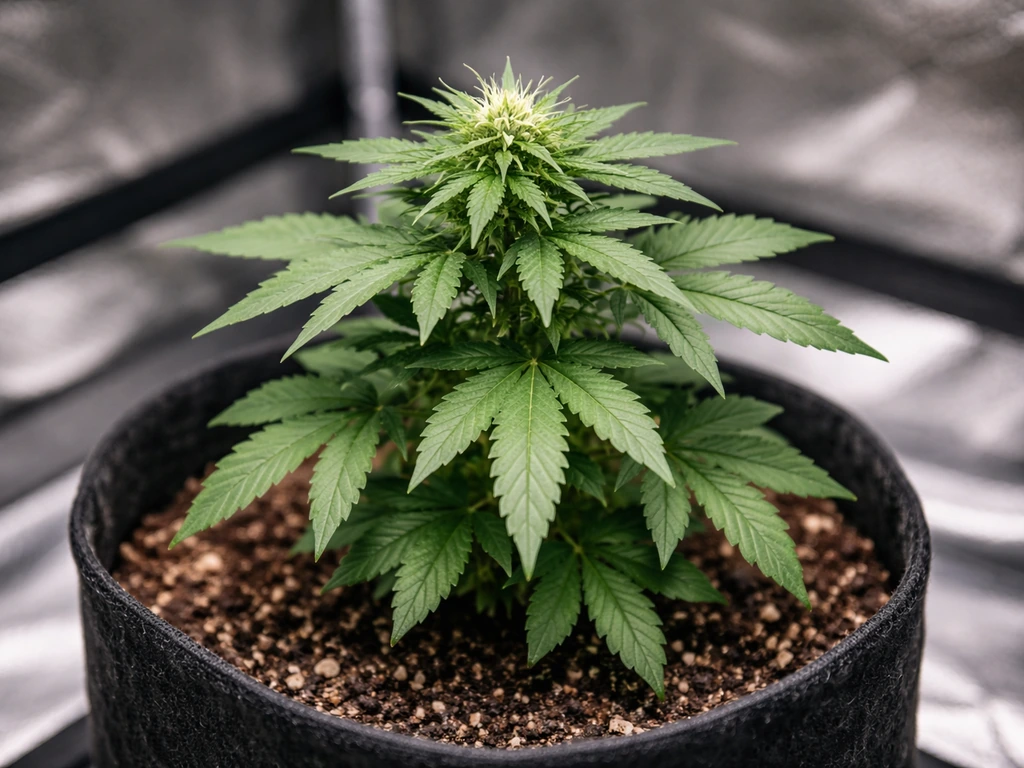
One pound per plant (roughly 450 grams) is achievable for a home grower, but it requires the right strain, enough light, good training, and a clean environment working together. Outdoors in a full growing season, a healthy photoperiod plant in good soil can hit that number and beyond. Indoors, it takes a proper high-intensity light covering a well-trained canopy, and it generally means letting the plant get big enough to use that light efficiently. It's not a casual outcome, but it's also not a mystery. Every lever that moves yield in the right direction is something you can control.
How to Grow 1 Pound Per Plant: Yield Guide for Beginners
Marcus Holbrook
4 Jul 2026
What '1 pound per plant' actually means (and when it's realistic)
Let's be honest about the numbers first. Research on outdoor cannabis reports average yields often well under a pound per plant, one 2026 study found an average of about 268 grams of dry flower per plant under real-world outdoor conditions. Indoor controlled-environment data from commercial and research grows puts per-plant yields in roughly the 300–600 gram range depending on setup, density, and light levels. A pound is about 454 grams, which puts it at the upper end of what most home growers actually produce. That doesn't mean you can't do it, it means you need to set up the conditions that push a plant toward its upper potential, not its average.
The biggest factors are plant size and canopy coverage, light intensity and uniformity, vegetative duration (how long you let the plant grow before flipping to flower), genetics, and how well you prevent stress. Outdoors, a photoperiod strain that gets a full summer season, deep roots in the ground, and direct sun for 10+ hours a day can absolutely exceed a pound. Indoors, you're controlling everything artificially, so you need to match every piece of the system, light output, plant training, feeding, and environment, to an equally high standard. Growing from a single seed and wondering how much you can pull from one plant is a separate question from building a repeatable system, but the fundamentals are the same. If you are also trying to figure out how to grow weed with one seed, start by choosing a photoperiod strain and then build your setup around light, training, and stress control one plant.
One more thing: always check the laws in your jurisdiction before you grow. Legal plant counts, possession limits, and home cultivation rules vary widely by state, province, and country. Growing responsibly within your legal allowances is the only way to enjoy this hobby long-term.
Choosing the right strain and setup for the job
Not every strain can hit a pound per plant regardless of how well you grow it. Genetics set the ceiling. For pound-per-plant goals, you want high-yielding photoperiod strains, varieties explicitly bred for volume, with descriptions like 'XL producer,' 'commercial yield,' or specific gram-per-watt claims from reputable breeders. Popular categories include large sativa-dominant hybrids, heavy indica strains like Northern Lights or critical-mass types, and modern hybrids bred for both yield and potency. Autoflowering strains are generally not the path to a pound per plant indoors, their fixed lifecycle and smaller size make it difficult, though outdoors in summer with ideal conditions some autos can surprise you. If your goal is one plant, one pound, choose a photoperiod strain with documented high yield genetics. If you want the practical steps behind the numbers, follow the full guide on how to grow one weed plant from seed to harvest photoperiod strain.
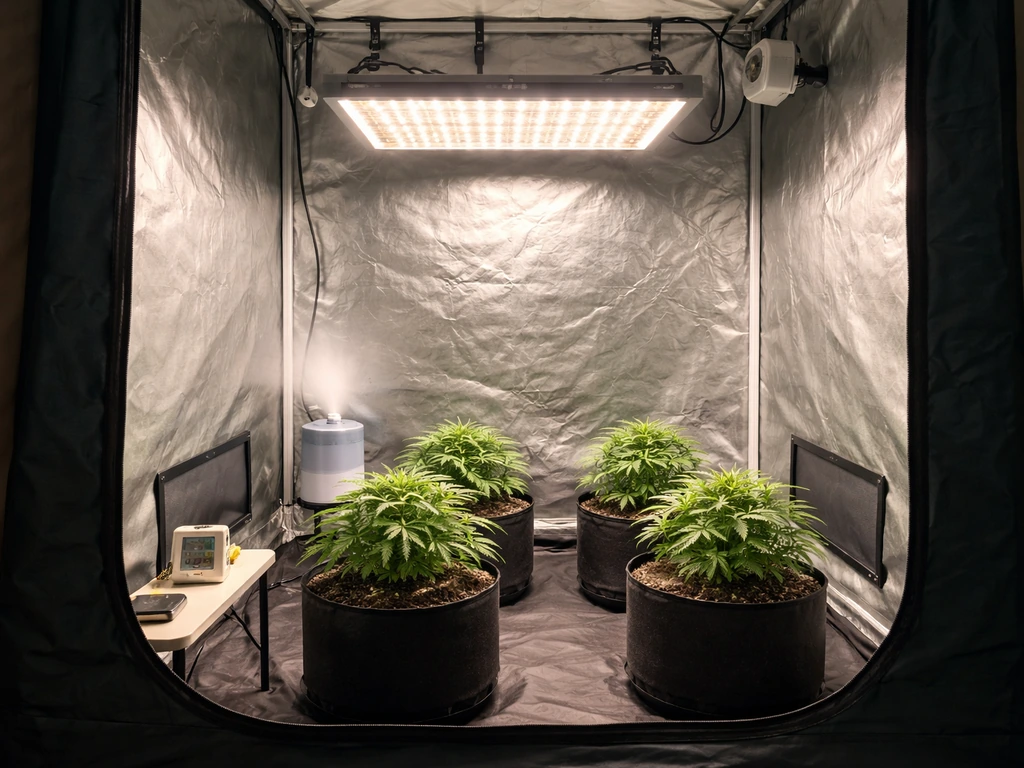
Your setup choice matters just as much. Indoors, a 4x4 foot tent (roughly 1.2x1.2 meters) is well suited to one large plant trained to fill the space. Outdoors, a full-season grow in the ground, not a container, gives the root system room to support a large canopy. Hydroponics (especially coco coir or deep water culture) can accelerate vegetative growth and push yields higher than soil in some setups, because nutrient delivery is more precise and roots can expand faster. Soil is more forgiving for beginners and still completely capable of hitting the target. The choice between indoor, outdoor, soil, and hydro comes down to your situation, all three paths can work when executed well.
| Setup | Pound-per-plant feasibility | Key requirement | Best for |
|---|---|---|---|
| Outdoor / in-ground soil | High (easiest path to 1+ lb) | Long veg season, full sun, healthy soil | Beginners with outdoor space |
| Indoor / soil in large pot | Moderate (achievable with good light) | 600–1000W HID or equivalent LED, 4x4 canopy | Year-round growers, privacy-focused |
| Indoor / coco or hydro | High (fastest vegetative growth) | Precise pH/EC management, high PPFD | Experienced growers or those willing to learn |
| Autoflower (any medium) | Low per plant indoors | More plants needed to match total yield | Speed and simplicity over per-plant weight |
Building the environment that actually drives yield
Light is the single biggest lever indoors
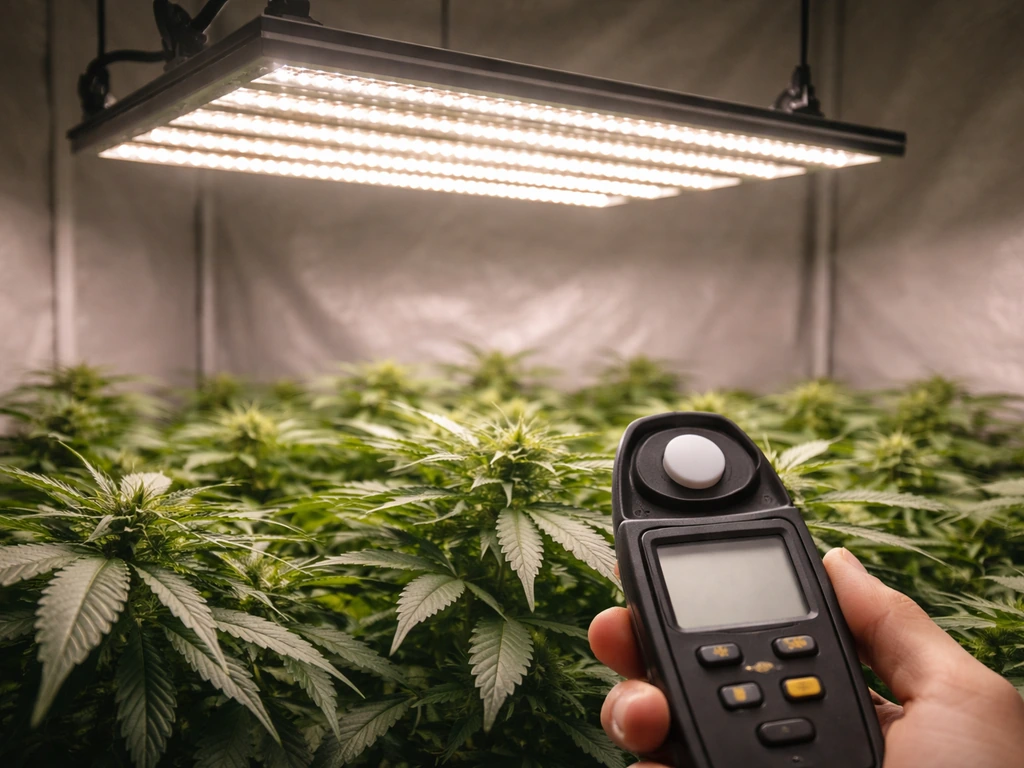
Cannabis yield responds directly to the amount of light delivered to the canopy. The metric that matters most is PPFD (photosynthetic photon flux density), measured in micromoles per square meter per second (µmol/m²/s). A daily cumulative version of this is called DLI (daily light integral), measured in mol/m²/day. For flowering cannabis indoors, a target DLI of roughly 30–45 mol/m²/day is a solid benchmark, which works out to approximately 700–1,050 µmol/m²/s average PPFD over a 12-hour photoperiod. If you use the formula DLI = 0.0036 × PPFD × hours, you can verify your setup hits that range with a light meter or a PAR meter app.
PPFD drops significantly with distance from the fixture, this is one of the most common reasons growers underperform. If your light is set too high above the canopy, the outer and lower parts of the plant may be receiving half the photons of the top cola. For a 4x4 canopy, a quality LED or HID fixture rated for that coverage area needs to be dialed in at manufacturer-recommended hanging height and ideally verified with a PAR reading at canopy level. For a pound-per-plant goal indoors, a 600–1000W HID (HPS or CMH) or a comparable quantum board LED drawing 500–800W from the wall is a realistic minimum for one large plant filling a 4x4.
Temperature, humidity, and airflow
Cannabis grows best in a fairly specific environmental window. During vegetative growth, target 70–85°F (21–29°C) with relative humidity (RH) of 50–70%. During flowering, drop temperature slightly to 65–80°F (18–27°C) and bring RH down progressively, aim for 40–50% RH through mid-flower and 40–45% in the final two to three weeks to protect against mold. High humidity late in flower is one of the most common ways growers lose weight and quality right at the finish line. A decent hygrometer, an oscillating fan inside the tent, and an exhaust fan with carbon filter running at appropriate speed are non-negotiable for a large indoor plant.
Outdoors, you can't control the weather, but you can choose your grow window and site. Full sun for at least 8–10 hours a day, good airflow around the plant (don't crowd it against a fence or hedge), and attention to local humidity patterns late in the season all make a difference. If you're in a humid climate, selecting mold-resistant genetics matters a lot.
Training techniques to maximize your canopy
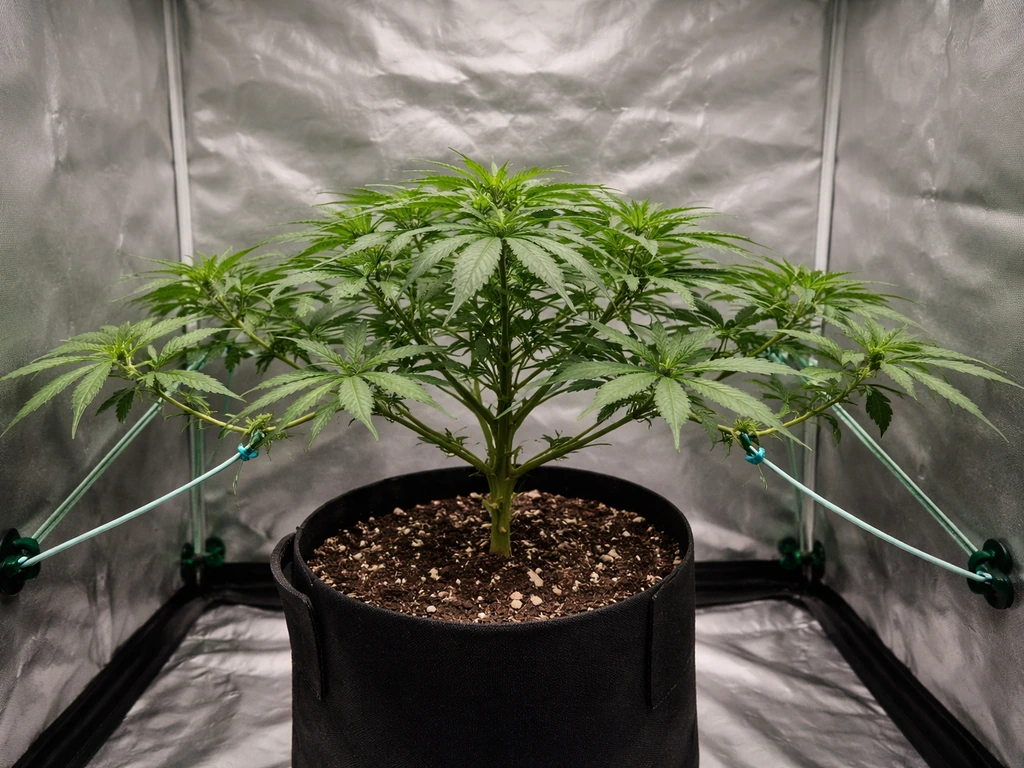
A single untrained cannabis plant will grow into a Christmas-tree shape, where most of the light hits only the main top cola and the lower sites stay small. Training breaks that pattern and turns one plant into a flat, even canopy where every bud site receives similar light intensity. This is how one plant actually produces a pound instead of a few fat colas and a bunch of popcorn. If you want consistent results, start by choosing a healthy mother plant and keeping it vigorous through regular pruning and stable light, feeding, and watering.
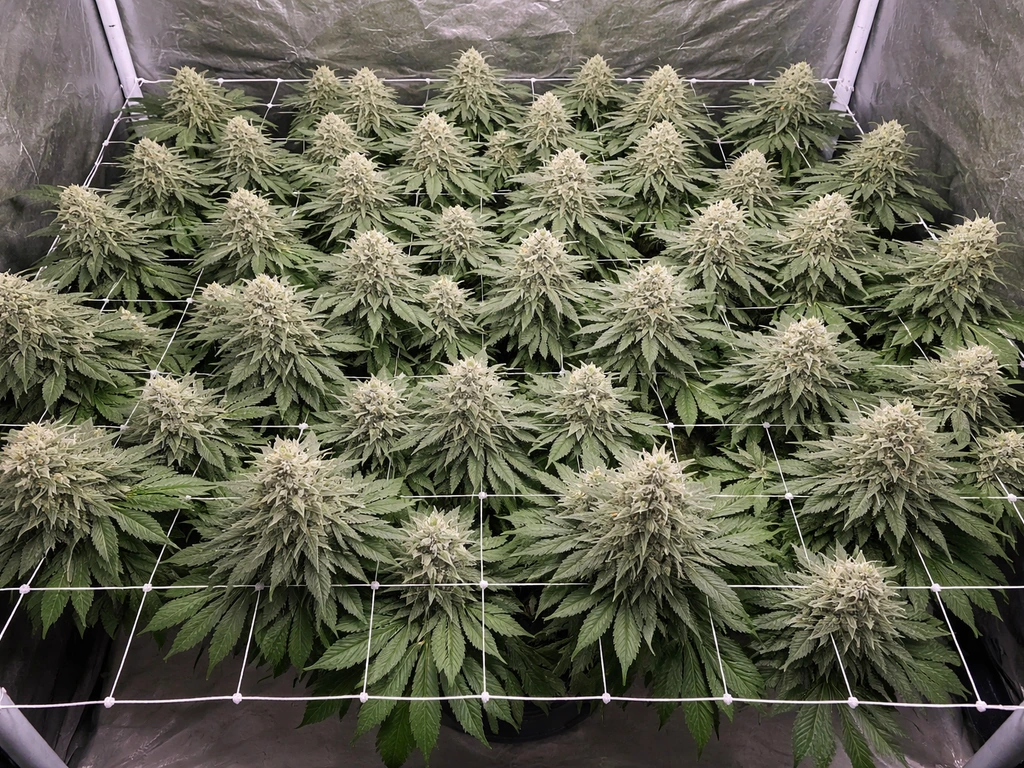
Low-stress training (LST) is the most beginner-friendly approach. You start bending and tying down the main stem as early as week 2 from seed, gradually pulling it horizontal and then tying down side branches as they grow. If you are wondering how much weed can one seed grow, start by looking at your light, training style, and growing conditions from seed onward. This creates multiple equal-height tops without cutting the plant. LST can continue through early veg and into the very start of stretch in week one or two of flower, then you stop and let the canopy lock in. Topping, cutting the main growing tip to create two main colas, is a higher-stress technique but extremely effective when done early (usually at the 4th or 5th node). Many growers combine topping with LST for a bushier, wider plant. SCROG (Screen of Green) takes this further by weaving branches through a horizontal net stretched across the canopy, creating an extremely even bud plane. For one large plant in a 4x4, SCROG is one of the most effective ways to push toward a pound indoors.
- Week 2–3 (from seed): Begin LST, gently bend and tie main stem horizontal
- Week 3–4: Top at the 4th or 5th node (optional but highly recommended for volume)
- Week 4–6: Continue LST on new growth, train all tops to roughly the same height
- Week 6–8 (pre-flip): Fill your SCROG net or spread canopy to cover the grow space evenly
- Flip to 12/12 (photoperiod): Stop aggressive training, let stretch happen naturally
- Week 1–2 of flower: Minor tucking or tying only — no major cuts or bends
Feeding for maximum production
Cannabis is a heavy feeder when conditions are dialed in, but overfeeding is just as common a mistake as underfeeding. The key is matching your nutrient inputs to the plant's stage and growth rate, and always maintaining proper pH so the plant can actually absorb what you're giving it.
In soil, maintain a root-zone pH of 6.2–6.8. In coco coir or hydro, keep pH at 5.8–6.2. These windows are not arbitrary, cannabis uptakes specific macro and micronutrients best within these ranges. Outside them, you'll see deficiencies even when plenty of nutrients are present in the medium, which is called nutrient lockout. Always add nutrients to your water before testing and adjusting pH, checking pH before adding nutrients gives you a misleading reading.
For EC (electrical conductivity, a measure of total dissolved nutrients in solution), commercial cannabis production references suggest a range of roughly 600–1,400 ppm (parts per million, using the 0.5 conversion) during vegetative and flowering phases, with higher values as plants peak in mid-flower and a deliberate reduction or flush in the final week or two before harvest. In coco/hydro systems, monitoring leachate (the runoff) EC is your most reliable way to spot salt buildup before it causes lockout. If runoff EC is significantly higher than your feed EC, it's time to flush with a pH-corrected, low-EC solution (around pH 6.0, EC 0.4 for coco) to reset the medium.
A simplified feeding framework looks like this: high nitrogen through vegetative growth to support rapid leafy development, then transition to higher phosphorus and potassium once flowering begins (often called a 'bloom formula'). Calcium and magnesium are frequently needed as supplements, especially in coco or RO-filtered water. Don't just follow a nutrient chart blindly, watch the plant. Yellowing lower leaves in late flower is normal; yellowing upper new growth is a sign of a real problem.
| Growth Stage | Target pH (soil) | Target pH (coco/hydro) | Approx. EC target (feed) | Key nutrients |
|---|---|---|---|---|
| Seedling (week 1–2) | 6.2–6.8 | 5.8–6.2 | Low (~300–500 ppm) | Minimal — plain water or weak veg formula |
| Vegetative (week 3–8) | 6.2–6.8 | 5.8–6.2 | 600–900 ppm | High N, moderate P/K, Cal-Mag |
| Early flower (week 1–3) | 6.2–6.8 | 5.8–6.2 | 800–1,100 ppm | Lower N, ramp up P/K |
| Peak flower (week 4–7) | 6.2–6.8 | 5.8–6.2 | 1,000–1,400 ppm | High P/K, maintain Cal-Mag |
| Late flower / flush (final 1–2 weeks) | 6.2–6.8 | 5.8–6.2 | 0–400 ppm | Plain or near-plain water |
Watering, plant health, and keeping stress under control
Watering is the part of growing that trips up beginners most often, usually by doing too much of it. Overwatering suffocates roots and invites root rot and fungus gnats. In soil, water when the top inch or two of the medium is dry and the pot feels noticeably lighter than when it was just watered. In coco, the opposite approach works better, coco is inert and benefits from high-frequency watering (daily or even twice daily for large plants), as long as drainage is good and you're fertigating (watering with nutrients) rather than plain water.
Defoliation is a useful tool but easy to overdo. The goal is to remove large fan leaves that are blocking light from reaching lower bud sites, not to strip the plant bare. A moderate defoliation at the flip to flower (removing 20–30% of shading fan leaves) and a second light pass around week 3 of flower can improve light penetration and airflow dramatically. Good airflow inside and around the canopy reduces humidity pockets, prevents mold, and strengthens stems, let fans move air through the canopy, not just across the top of it.
Controlling stretch during the first two to three weeks of flower is also important for yield. Some stretch is healthy, buds need node spacing to develop properly. But excessive stretch (plants doubling or tripling in height) means you were either using a very sativa-dominant strain, your light was too far away during veg, or your night temperatures were too warm. If stretch is a problem, drop the temperature difference between lights-on and lights-off slightly, and make sure your canopy is close enough to the light when you flip.
Harvest timing: don't lose weight at the finish line
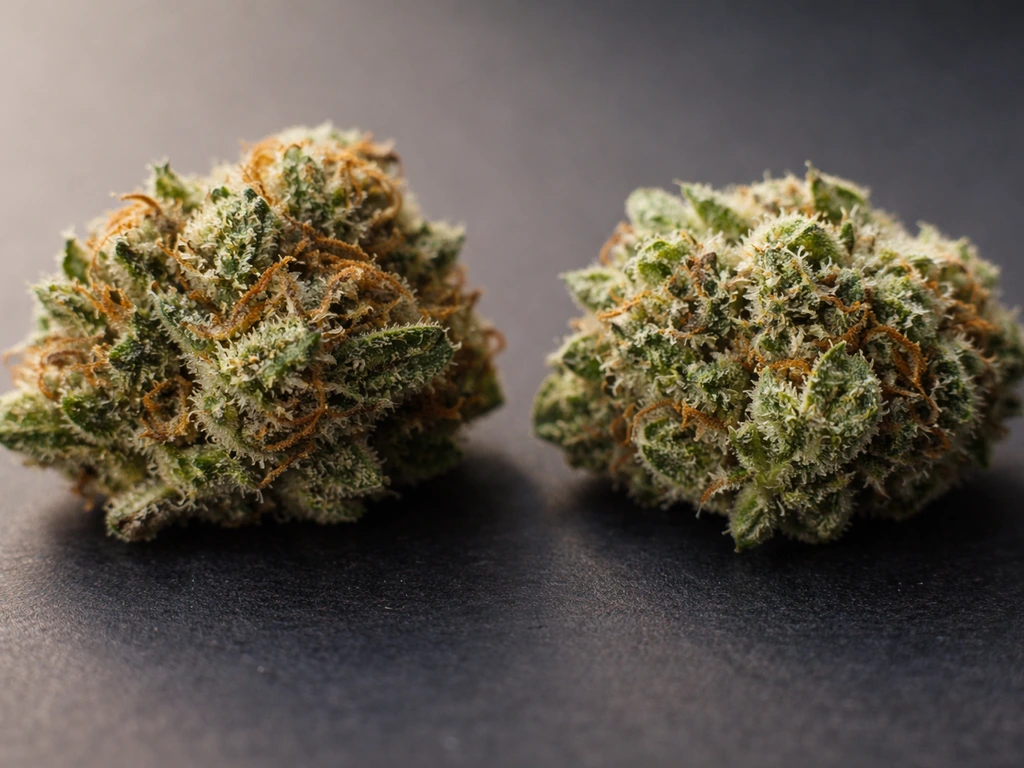
Harvesting too early is one of the most common ways growers leave yield on the table. Buds continue developing and adding mass in the final two to three weeks of flower, and cutting early can cost you 15–25% of your final weight. The most reliable harvest indicator is trichome color, inspected with a jeweler's loupe (30–60x) or a digital microscope. You're looking for trichomes (the tiny mushroom-shaped resin glands on buds and sugar leaves) to shift from clear and glassy to milky white, and then some portion shifting to amber. Clear trichomes mean the plant is not ready. Mostly milky with 10–20% amber is the sweet spot for most growers balancing potency and weight. Mostly amber means you've peaked and are moving past optimal.
Pistil color (the tiny orange or red hairs on buds) is a useful rough guide, when 70–80% of pistils have darkened and curled in, you're probably close, but pistil color can shift due to environmental conditions and isn't as reliable as trichome inspection on its own. Use pistils as a prompt to pull out the loupe, not as the final call.
After harvest, how you dry and cure matters for preserving weight and quality. Hang whole branches or cut plants in a dark, well-ventilated room at 60–70°F (15–21°C) and 45–55% RH. Drying too fast (under 5–6 days) produces harsh, poorly developed buds. Drying too slow in high humidity risks mold. The goal is a slow, even dry over 7–14 days until small stems snap cleanly. Then move to glass jars for curing, burping daily for the first week or two to release moisture. Proper drying and curing maintains final weight while dramatically improving quality, rushing this phase loses both.
Troubleshooting the most common yield killers
Most growers who fall well short of their target yield can trace it to one or more of these problems. Going through this checklist honestly is the fastest way to find your specific weak link.
Light too weak or uneven
This is the number one limiter indoors. If your light isn't delivering 700+ µmol/m²/s at canopy level across the full grow space, you simply can't hit high yields no matter what else you do. Check your PPFD at multiple points across the canopy, not just the center. Cheap blurple LED panels with inflated wattage claims are notorious for delivering far less PPFD than advertised. Invest in a quality quantum board LED or HID fixture matched to your canopy size, and verify it with a PAR meter.
pH and nutrient issues
If your pH drifts outside the target range for your medium, the plant locks out nutrients regardless of how much you're feeding. Classic signs include brown leaf tips (nutrient burn from salt buildup), yellowing between veins on new growth (magnesium or iron deficiency from high pH), or general paleness and slow growth (underfeeding or low pH lockout). Get a reliable pH pen, calibrate it regularly, and check your feed solution and runoff every single watering. Don't guess on pH.
Heat and cold stress
Temperatures above 85°F (29°C) at canopy level slow growth, reduce potency, and cause foxtailing (buds stretching into long, thin, airy structures instead of dense colas). Below 60°F (15°C), nutrient uptake slows significantly and plants become more susceptible to mold. Both extremes cost yield. If your tent runs hot, improve exhaust airflow first, then consider switching from HPS to LED (which produces less radiant heat), and add an AC unit if needed.
Humidity problems and mold
Botrytis (bud rot) and powdery mildew can devastate an otherwise healthy plant in the final weeks of flower. Bud rot hides inside dense colas and you often don't see it until you cut a bud open. Prevention is the only cure: keep RH under 50% during flower, run oscillating fans through the canopy, and remove damaged or dying leaves promptly. If you spot any gray, brown, or fuzzy patches on buds, remove that section immediately to prevent spread. For outdoor growers in humid climates, choosing open-structured, mold-resistant varieties is a yield-preservation decision.
Pests
Spider mites, fungus gnats, thrips, and aphids all reduce yield by stressing the plant and damaging leaf tissue. Regular inspection, checking the undersides of leaves every few days, catches infestations early when they're easiest to address. Sticky yellow traps catch flying pests and give you early warning. Keep your grow space clean, don't bring outdoor soil inside, and quarantine any clones before introducing them to your main space. For active infestations during veg, neem oil or insecticidal soap can work well. During late flower, avoid foliar sprays on buds.
Improper or skipped training
An untrained plant in a 4x4 space with a 600W light will give you one big cola and a lot of small ones, total yield well under what the same plant, trained flat across the canopy, would produce. If you skipped training this grow, start planning it for your next one. If you want a steady supply for future runs, learning how to grow a mother plant weed can make planning your next grow much easier. LST is low-risk enough that even beginners on their first plant should try it. The difference in final yield between a well-trained and untrained plant under the same light is often 30–50%.
Getting to a pound per plant is a system problem, not a single-step fix. Each element, genetics, light, environment, training, feeding, and timing, builds on the others. If you're new to growing a single plant from seed and want to understand the full scope before diving into yield optimization, the fundamentals of how one plant grows and what it needs are worth studying in their own right. If you want the best shot at your target, follow this same approach for how to grow 1 weed plant step by step from germination to harvest one plant from seed. But if you apply the framework in this guide consistently, a pound per plant is a realistic and repeatable target.
FAQ
If I hit the right PPFD and use a good strain, why am I still not getting close to 1 pound per plant?
The next most common limiter is canopy uniformity. If the light is strong but only the top center is getting it, lower sites stay dim and you lose mass. Measure PPFD at multiple points (center plus corners) and confirm your training technique actually keeps most bud sites within the same light level.
How big should my plant get before I flip to flower to target around 1 pound per plant?
Aim for a canopy that fills the footprint, not just a tall plant. A practical rule is that by flip, the canopy should be wide and level enough that most branches can receive near-peak light, then you stop training as the stretch ends so the structure can lock in.
Is it ever worth doing a longer veg period to increase yield per plant?
Only if it results in a larger, well-lit canopy. A longer veg without improving light coverage or training usually adds stems and leaf mass but not proportional bud sites. If your tent, airflow, and light footprint stay the same, you mainly risk reduced flowering efficiency.
Can I use autoflowers to reach 1 pound per plant indoors?
It’s difficult because autos typically finish before you can build and fill a large canopy, especially under a standard indoor schedule. If you insist, treat it like a yield optimization challenge from the start (bigger container, strong light, early training), but expectations should be lower than with photoperiod plants.
What container size and root volume help most for a pound-per-plant goal indoors?
Bigger roots support more stable watering and feeding, especially when aiming for high DLI and large canopy. Use at least a mid-size pot for soil, and in coco plan for frequent feeding with excellent drainage. If roots are rootbound early, you often see stalled growth and a smaller final bud mass.
Should I flush before harvest to protect the final weight?
Instead of a dramatic, long flush, many growers focus on preventing late nutrient issues and keeping pH stable. If you do reduce nutrients, do it gradually and base it on runoff pH and EC trends, because overly harsh flushing can dry the plant too much and reduce final mass.
How do I know if my pH problem is nutrient lockout versus an overfeeding or watering issue?
Check the pattern. Nutrient lockout from pH drift often shows symptoms on newer growth (especially for iron or magnesium) while overfeeding can cause rapid tip burn and general dark, clawed leaves. Also verify runoff pH each watering cycle, because dry backs and missed feedings can mimic deficiency symptoms.
What’s the safest way to use defoliation without hurting yield?
Keep defoliation focused on blocking leaves, remove small percentages at a time, and avoid cutting major structural fans. The best timing is around flip and after stretch, when the plant has momentum to regrow without stalling. If airflow is already good, don’t keep stripping beyond what’s needed to expose bud sites.
If my temperature is within range, why am I still getting foxtailing or airy buds?
Foxtailing can also be caused by light intensity that is too high for the plant’s ability to tolerate it during late flower, or by inconsistent heat at canopy level, not just average room temperature. Use canopy-level readings, and consider whether your DLI is climbing too aggressively as you approach peak bloom.
How should I set up drying to avoid losing yield to mold or harshness?
Use slow, even drying with controlled humidity, aim for 7 to 14 days until small stems snap cleanly, and keep jars sealed only after the dry target is reached. If your room humidity spikes, increase airflow slightly and ensure buds are not packed tightly, because trapped moisture is what leads to rot.
What should I inspect to catch bud rot early, since it hides inside dense colas?
During the last few weeks, open up the densest areas and look for gray-brown discoloration or fuzzy growth, especially where airflow is worst. If you find suspect tissue, remove that part immediately, keep the cut area isolated, and improve airflow so it doesn’t spread to neighboring buds.
How often should I check runoff EC and pH, and what if runoff EC is higher than my feed EC?
For coco and hydro, check runoff EC and pH periodically, not just once, because salt buildup develops over multiple irrigations. If runoff EC climbs well above your feed EC, it’s a sign salts are accumulating and you should perform a pH-corrected, low-EC reset to bring the medium back into range.
Next Article
How Much Weed Can One Seed Grow and How to Maximize It
Realistic yield from one cannabis seed, what limits it, and steps to maximize flower at home from seed to harvest.